- In our Trail Notes series, we share Expedition team perspectives from the journeys we are on with founders.
- This edition introduces Essential Domain Intelligence: our view of what will set apart the companies that compound value in the AI era.
We partner with a particular kind of company. Bootstrapped, founder-led, and growing fast, often 50% to 150%+ a year. Not because they have spent heavily to manufacture that growth, but because they have built a product so good the market pulls them forward. These are domain-expert founders who understand their customers better than anyone else, and who have codified that understanding into software that wins. For two decades, that expertise expressed itself as workflow.
Today, AI puts a fair question to every software founder, and to everyone who backs them: if a general-purpose model can write the code, draft the document, answer the query, and increasingly take the action, where does durable value still live and compound? Our answer is what we call Essential Domain Intelligence.
What we mean by Essential Domain Intelligence
For most of the software era, value accrued to workflow platforms and systems of record. They stored information, coordinated activity, and helped people do their jobs more efficiently. AI introduces a new category: systems that accumulate, compound and apply domain-specific intelligence.
These systems do more than organise work. They observe it, learn from it, and improve their ability to make decisions over time. Their advantage lies in the feedback loops through which they convert activity into intelligence. As intelligence compounds, software moves closer to the decision itself. The commercial opportunity expands accordingly, from selling tools that support labour to delivering outcomes that replace it.
Essential Domain Intelligence is not simply knowledge of a domain, though that is a vital component. Rather, it is intelligence that the domain depends upon to function effectively. It is embedded in the critical decisions, constraints, and judgement calls that determine outcomes. Remove it, and performance deteriorates. Improve it, and the economics of the entire system improve with it.
The gap this opens is not incremental
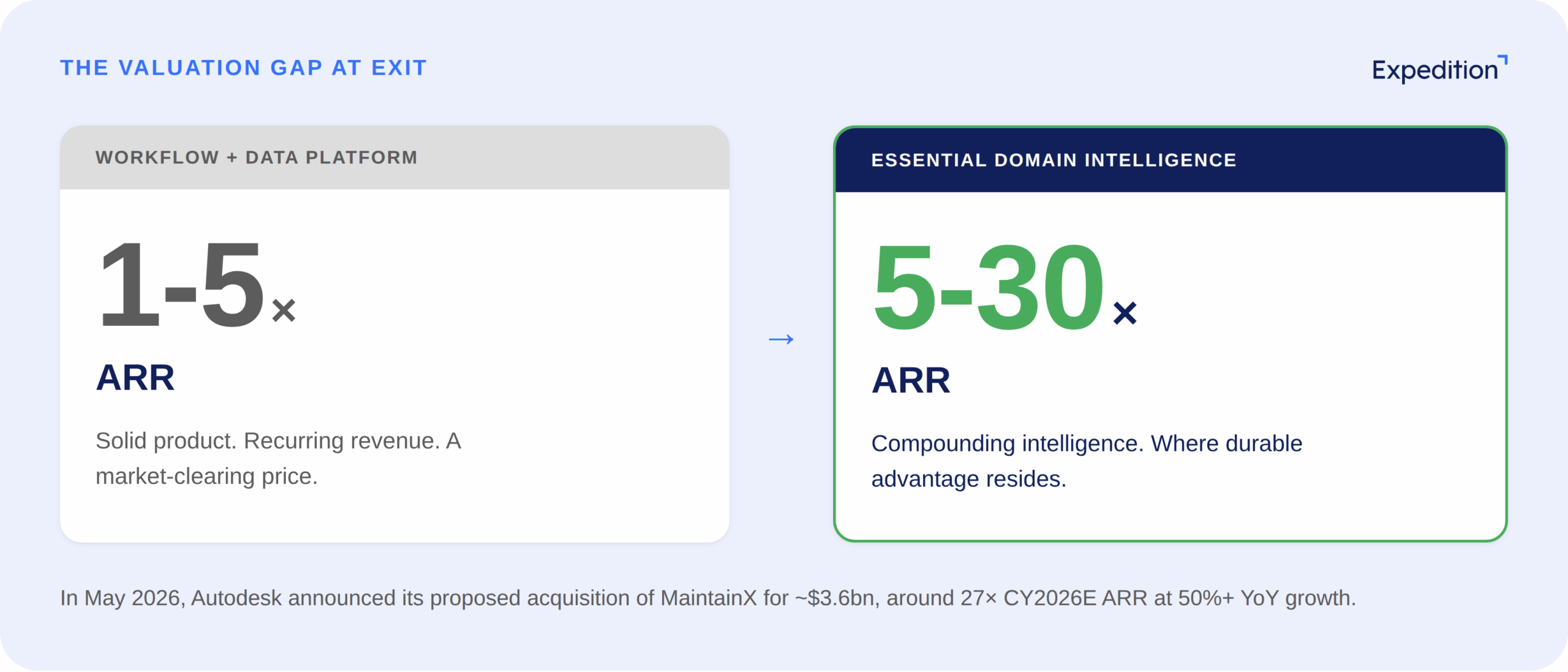
From what we see in Q2 2026, the private company exit market for workflow platforms with healthy combinations of growth, retention and profitability is clearing at 1-5x ARR. The market for companies that are capturing the data exhaust from that workflow and manufacturing it into compounding domain intelligence is clearing at multiples that can be an order of magnitude higher.
Few companies run a closed intelligence loop across their entire customer base today. But those that do are beginning to attract premium valuations because they possess something that cannot be purchased off the shelf: a proprietary system for converting work into intelligence.
Autodesk’s agreement to acquire MaintainX at around 27x 2026E ARR, announced in May 2026, illustrates the point. On the surface, MaintainX appears to be a maintenance workflow platform in a mature category. In reality, the workflow is only the point of capture.
Every inspection, repair, failure, intervention and outcome generates information about how physical assets behave in the real world. Over time, MaintainX has accumulated a proprietary understanding of asset performance across millions of operational decisions. That understanding cannot be recreated simply by training a better model; it requires years of participation in the workflow that generates it. The premium was not paid for the workflow alone; it was paid for the intelligence that the workflow had been manufacturing over time.
The six properties of Essential Domain Intelligence
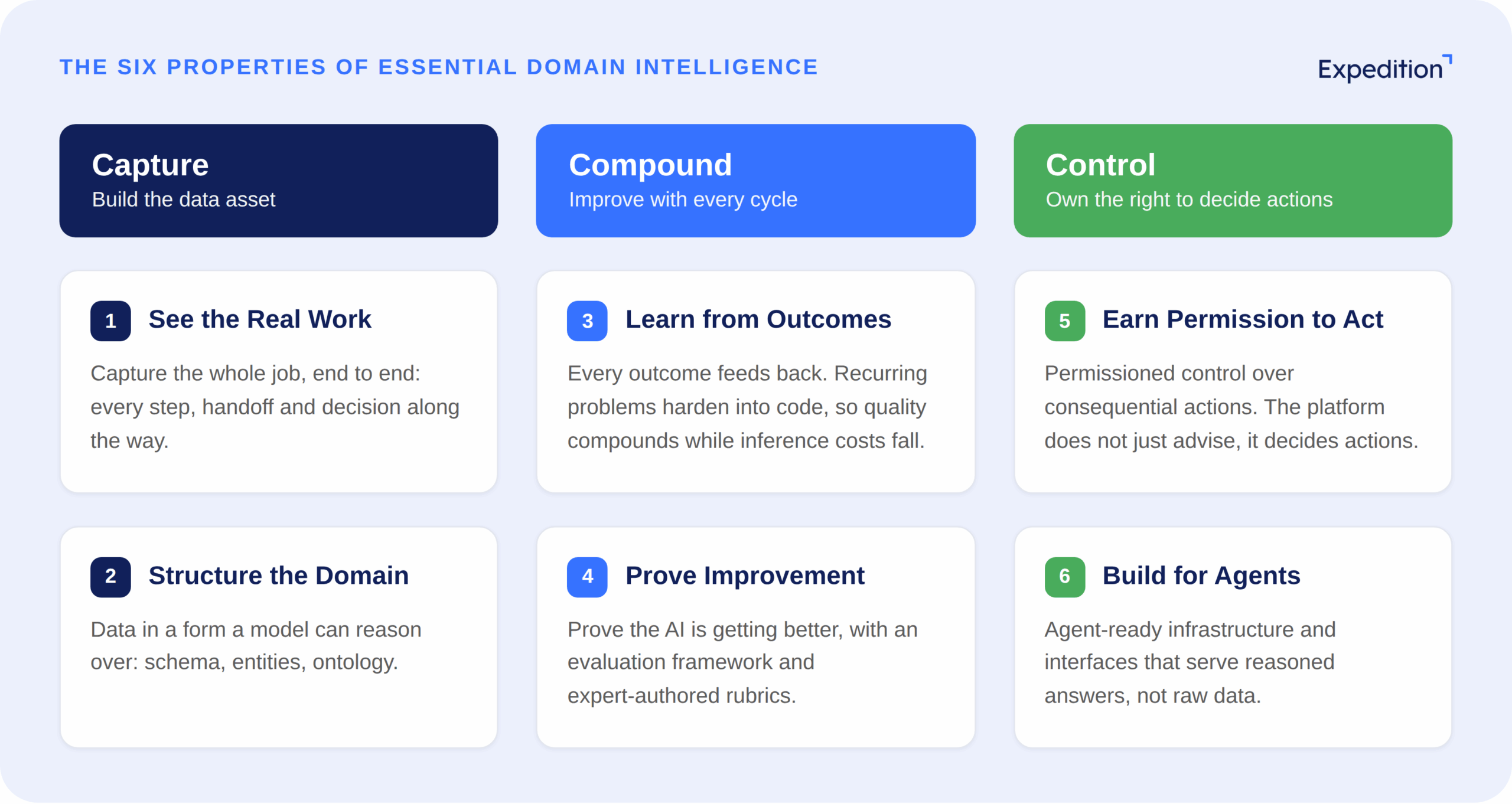
We believe six properties separate a domain intelligence platform from a workflow platform. We group them in three pillars: Capture, to build the data asset; Compound, to improve with every cycle; and Control, to own the right to decide actions.
Capture: build the data asset
1) See the real work. Do you capture what actually happens, not just what people record? The intelligence lives in the gap between the two: the exceptions, the manual overrides, the judgement calls and edge cases that never make it into the official record. This is the difference between a system of record and a source of intelligence: one stores what was entered, the other captures how the work actually runs.
Beyond software, proprietary hardware, regulation, data rights, distribution and trusted industry partnerships can all provide additional opportunities for privileged access to capture relevant work.
2) Structure the domain. Is your data in a form a model can reason over, organised around the core concepts, entities, relationships and constraints of your domain, or is it raw signal and free text? Better models working on badly structured data still produce unreliable answers.
Compound: improve with every cycle
3) Learn from outcomes. Does the platform stay in the workflow long enough to see whether the decisions made on it actually worked, and does it learn from the answer? Without the loop, the data accumulates but the intelligence does not. A business can hold years of history and still be static.
Learning compounds on cost as well as quality. Once a problem is solved often enough, it can be hardened into deterministic code, so costly inference runs only at the moving frontier and the unit economics improve as the platform scales.
4) Prove improvement. How do you know the system is getting better, rather than simply becoming more sophisticated? We believe the strongest answer is to evaluate it against the work customers actually pay for. The best evals – the tests you grade the system on – are not generic benchmarks, instead they encode the judgement, constraints and success criteria of a specific domain.
Over time, these evals become more than a measurement system. They become a mechanism for converting domain expertise into software. They identify failure modes, guide improvement, and create the feedback loops through which intelligence compounds. Building them requires deep expertise, outcome visibility and an installed base of real-world work, making them difficult to replicate.
They also provide continuity as foundation models evolve. When the model changes, the question remains the same: does the system still produce the outcomes the domain demands? The companies that can answer that question with confidence will improve faster than those relying on model capability alone.
Control: own the right to decide actions
5) Earn permission to act. This is where compounding intelligence becomes economic value. Translating that domain intelligence into autonomous decision making and using the feedback loop to continually build trust. But that trust must be earned progressively. The strongest platforms do not begin by taking control of an entire workflow from day one. Instead, they start narrow, focusing on a single area where trust is easiest to establish, demonstrate reliability, and close the loop on outcomes, before gradually earning the right to take on more consequential work.
Autonomous decision making, powered by domain intelligence, gains trust through this reliability and accuracy, but also through its auditability – a platform trusted to decide can show what actions it decided, and why.
6) Build for agents. Increasingly, software is not being consumed directly by humans, but by AI systems acting on their behalf. In this model, the agent should not need to reconstruct the expertise of the domain for itself. Instead, it should be able to rely on the judgement embedded within the platform. The most valuable systems provide domain intelligence rather than raw information: context applied, constraints encoded, and recommendations shaped by deep understanding of the work being done.
As software consumption shifts from interfaces to outcomes, the most valuable platforms will not be those that expose data, but those that provide trusted judgement. That is the difference between being consulted with and being delegated to.
We see these pillars at work inside our portfolio companies at Expedition. Dougs has codified deep accounting and tax expertise into a proprietary expert system that now runs the books for tens of thousands of small businesses across France. Dougs delivers the outcome of filed accounts and optimised financial decision making, displacing traditional accountants who are using third-party software to deliver the same outcome at materially higher cost. Omilia is another Expedition portfolio company that is mastering the automation curve of its industry: serving enterprise contact centres, Omilia is learning from billions of minutes of regulated calls and resolutions to deliver accuracy, reliability and value that no generalist model or LLM-wrapper can match.
Three ways to express it
Once a company is accumulating domain intelligence, the question becomes how to commercialise it – and the prize is no longer just the software budget, but the far larger pool of labour spend that sits around it. We see three durable shapes:
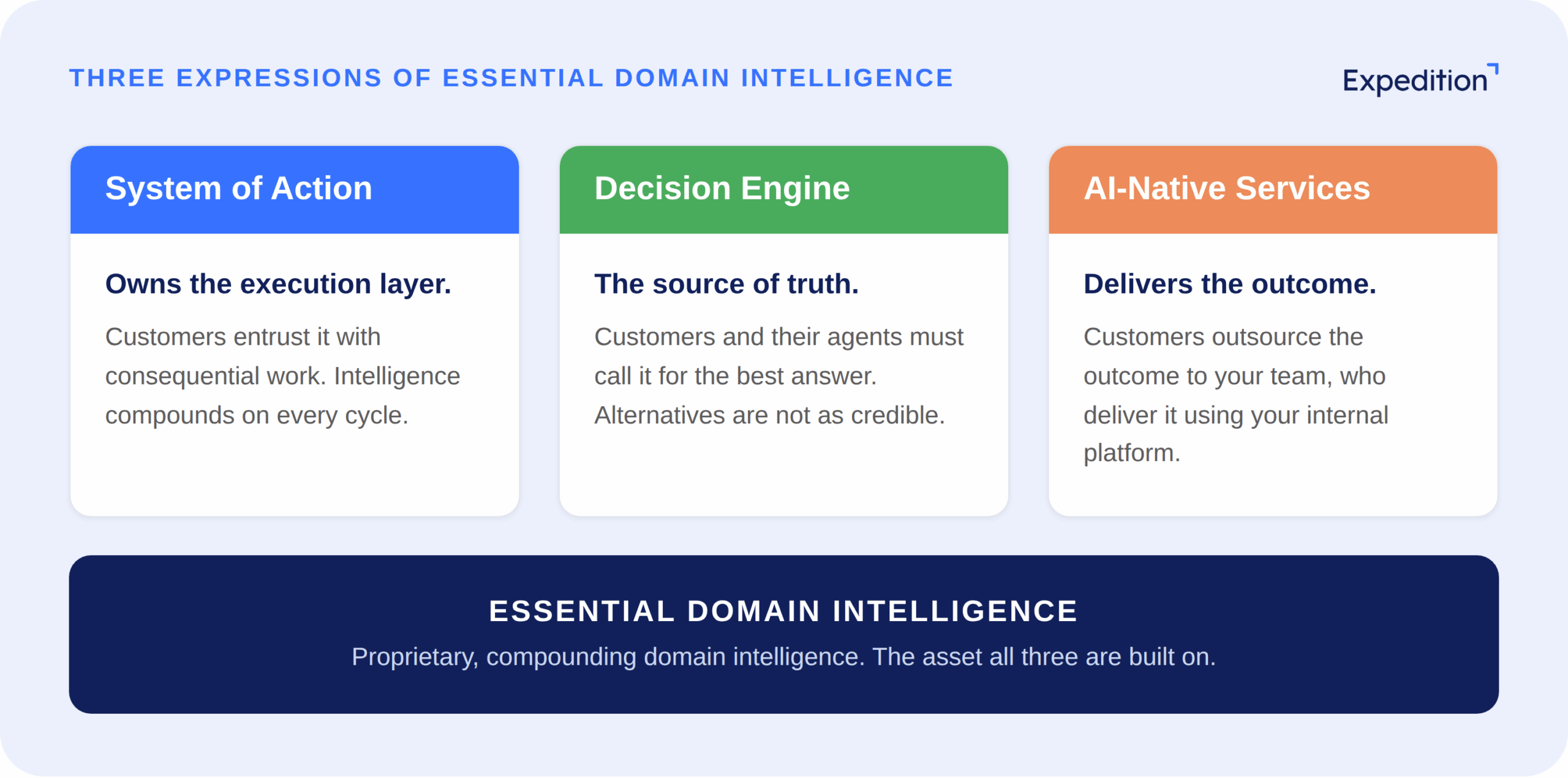
A system of action owns the execution layer in its market. Customers entrust the platform to complete consequential work, end-to-end, and it compounds intelligence on every cycle.
A decision engine is the source of truth a domain consults. Customers, and increasingly their agents, must call it for the ground-truth answer, because the alternatives are not as credible.
AI-native services go one step further: the customer outsources the outcome to you. Your team delivers the service and is powered by an internal platform built on essential domain intelligence.
Dougs is exactly this third shape: customers buy an accounting service, and Dougs’ accountants deliver it on the company’s own AI platform. It is the shift sometimes described as service-as-software, with pricing attached to the result, not the seat. What the customer buys is the outcome, and the more intelligent the platform, the more of that outcome it can deliver without human effort, and the more that gross margins tend towards software rather than services.
The most exposed position is none of these. It is the workflow tool sitting adjacent to an intelligence play, attacked from below by LLM-native challengers and from above by larger orchestration platforms, with no compounding asset of its own.
Deep domain expertise is still where winning begins
We have always partnered with founders who win with substance in markets where capital is not the moat. Deep domain expertise, patiently codified, was the edge before AI. It is the edge now. The key is to build that expertise into compounding domain intelligence. The expertise no longer lives only in the screens; it lives in the intelligence underneath them, and in the right to put that intelligence to work.
As frontier models improve, value keeps shifting from capability to context. The work, for every software company, is to move revenue from the workflow toward the intelligence the domain cannot do without. The further along that journey, the more each frontier release works for you rather than against you.
What comes next
Most companies, whether building with the agility of an AI native, or the trusted distribution of domain expert software, can evidence one or two of these foundations today. That is not a criticism. It is simply where the work now sits, and the value created over the next few years will depend, materially, on progress against the others.
Some companies will conclude there is no clear path to building an essential domain intelligence platform from where they stand today. Knowing that early matters too. The acquirers building these platforms are assembling them now, and a strong workflow and data asset commands its best price while it still fills a gap in someone else’s vision.
A large wave of bootstrapped company creation and transformation is in motion, led by founders who see the opportunity to build essential domain intelligence and are harnessing the ever-growing capabilities of AI to build it with speed and efficiency. We are partnering with those founders, providing growth capital and shareholder liquidity, and supporting with specialist operating resources across key growth topics including talent, go-to-market, pricing and international expansion.
If you are an ambitious founder with a use for capital and partnership on your path to domain AI leadership, we’d love to meet.
About Expedition Growth Capital
Expedition is a software & AI specialist growth equity firm, with offices in London and Boston. Expedition partners with ambitious, rapidly growing companies that have achieved significant traction with little or no external funding. The firm brings capital for growth initiatives and shareholder liquidity, highly relevant operational expertise, and a trusted track record of respectfully partnering with founders on their path to category leadership. For more information, please see Expedition.capital or follow Expedition on LinkedIn.